UGREEN HomeAgent: A Local Smart Home Hub Built for Privacy
Cloud-connected smart homes have been the standard for more than a decade. While cloud technology has made smart devices easier to set up and access remotely, it also comes with a major concern: privacy. Your cameras, sensors, voice commands, and other smart-home data may depend on remote servers to function.
UGREEN is now taking a different approach with HomeAgent, a new turnkey smart home platform designed to keep more of your data and processing inside your home.
One Hub for Your Smart Home
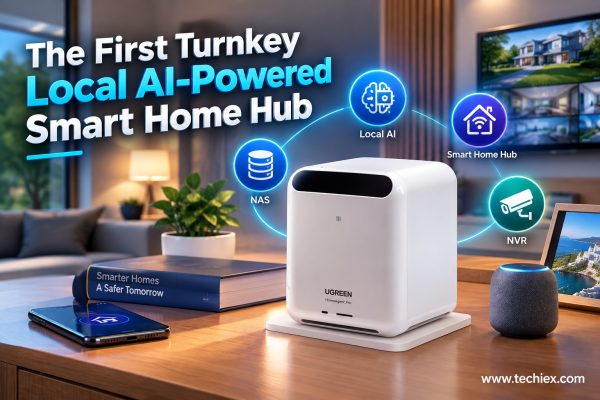
UGREEN’s HomeAgent combines several technologies into a single system, bringing together a NAS, local AI platform, smart home hub, and NVR.
The company is building on its experience in network-attached storage. UGREEN entered the NAS market in 2020 after establishing itself primarily through chargers and mobile accessories. Since then, it has expanded its NAS lineup with increasingly powerful systems.
With HomeAgent, however, UGREEN is moving beyond storage.
The company envisions the platform as the central brain of a local-first smart home, handling smart-home controls, video surveillance, AI processing, and data storage without relying heavily on the cloud.
A Growing UGREEN Smart Home Ecosystem
HomeAgent isn’t simply a standalone hub. UGREEN is also developing its own ecosystem of compatible smart-home devices.
At launch, the ecosystem includes:
- An indoor security camera
- Two outdoor security cameras
- A smart speaker
- A color E-Ink photo frame
Because these devices are designed specifically for the HomeAgent platform, they can interact with one another natively.
For example, a voice command through the UGREEN smart speaker could trigger a camera to capture an image, which could then be displayed automatically on the E-Ink photo frame. This kind of device-to-device interaction is designed to happen within the local ecosystem.
The ecosystem is still relatively small, but UGREEN is also supporting Matter, giving HomeAgent the ability to work with a wider range of compatible smart-home products. The company has also indicated that some level of Home Assistant support should arrive before launch.
Local AI at the Center
The biggest difference between HomeAgent and many traditional smart-home hubs is its emphasis on local processing.
Rather than sending every request to a remote cloud server, HomeAgent is designed to perform AI processing locally. The same local-first philosophy applies to video recordings and smart-home control.
UGREEN plans to offer three HomeAgent models: HA100, HA100 Pro, and Master Agent.
The models differ significantly in their AI capabilities:
- HA100: Designed to run local AI models with up to 4 billion parameters.
- HA100 Pro: Capable of running models with up to 32 billion parameters.
- Master Agent: Designed for substantially larger models, supporting up to 122 billion parameters.
This gives users the option to choose a system based on how much local computing power they need.
Why Local Smart Homes Matter
The move toward local smart-home processing could be particularly important as homes become increasingly connected.
Security cameras can generate enormous amounts of sensitive information. Voice assistants can hear conversations. Smart-home systems can reveal when people are home, when they leave, and even their daily routines.
Keeping more of this information inside the home can reduce dependence on cloud services and potentially give users greater control over their data.
UGREEN’s HomeAgent is therefore more than another smart-home hub. It represents an attempt to combine local AI, home automation, surveillance, and personal storage into one centralized platform.
If UGREEN can deliver on its promise, HomeAgent could signal a shift away from the cloud-dependent smart homes that have dominated the market for years—and toward smarter, more private systems that do more of their work right at home.
Powerful, But Not Exactly Affordable
There is, however, one major drawback: price.
The flagship Master Agent packs an impressive 2,070 FP4 TFLOPS of computing power and 128GB of RAM, making it an extremely powerful machine for running AI locally. But that performance comes at a steep cost. Its retail price is $19,999, although UGREEN is offering a significantly lower $9,999 pre-order price.
For most consumers, that’s still far beyond what they’d be willing to spend on a smart home hub. There’s no denying, though, that the Master Agent offers an extraordinary amount of local AI processing power.
The more affordable options are the HA100 and HA100 Pro, priced at $1,799 and $5,999, respectively. Their pre-order prices start at $899 for the HA100 and $2,999 for the HA100 Pro.
For the average smart-home user, the HA100 or HA100 Pro should provide more than enough performance. The HomeAgent platform is now available for pre-order, with UGREEN planning to launch its Kickstarter campaign in October.
How Local Is “Local”?
There is still one important question that UGREEN hasn’t fully answered—and we may not know the answer until HomeAgent begins shipping.
Does any user data actually leave the HomeAgent ecosystem?
UGREEN describes HomeAgent as a local-first platform, promising local AI processing, local video storage, and local smart-home control. But “local-first” doesn’t necessarily mean “100% local.”
Until independent hands-on testing can examine how the system handles data and whether any information is transmitted to external servers, it’s too early to say that HomeAgent is completely cloud-free.
That could ultimately be the feature that makes or breaks UGREEN’s ambitious smart-home platform: whether it can truly deliver the privacy and independence that local AI promises.
Source: howtogeek Edited by Bernie

Leave a Reply